Wipeout
Spring reverb: a model of a real two-spring tank, with its drip, splash and wash.
Parameters
| Parameter | Range | Default |
|---|---|---|
| Dwell | 0 – 100 % | 50 % |
| Decay | 1 – 4.5 s | 3 s |
| Tone | 0 – 100 % | 50 % |
| Damping | 0 – 100 % | 50 % |
| Diffusion | 0 – 100 % | 50 % |
| Chirp | 0 – 100 % | 100 % |
| Low Cut | 20 – 1000 Hz | 20 Hz |
| High Cut | 1000 – 12000 Hz | 12000 Hz |
| Width | 0 – 100 % | 0 % |
| Tank | Classic, 70s | Classic |
Overview
Wipeout is a spring reverb: the drip on a picked note, the splash when you dig in, and the wash behind a chord. It holds models of two real two-spring tanks, not recordings of them, so the springs respond to how hard you drive them, the way an amp’s reverb does. In short, it models how sound travels along the two springs and bounces back.
The TYPE button chooses the tank:
- Classic: full and even, with a smooth wash. This is the default.
- 70s: thin and bright, with a quick sizzle of high echoes on top of the drip and less of the low end. It sits quieter under low notes than Classic at the same Mix.
At its defaults it sounds like the tank it was measured from: mono, the same on both outputs, with the lowest notes left mostly dry, as a real tank does.
On the pedal
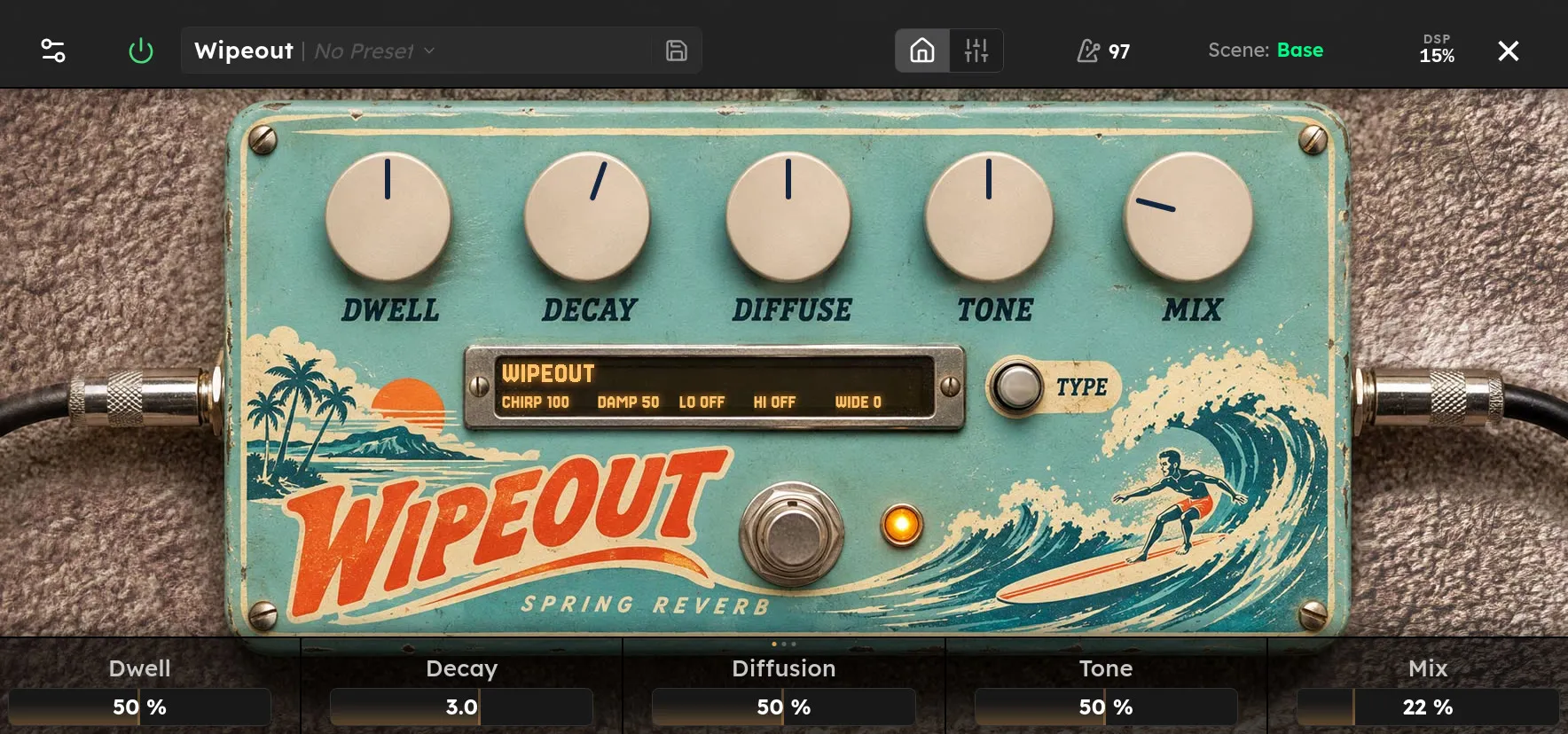
- Five knobs, left to right:
- Dwell: how hard the springs are driven. Higher is louder and splashier, and hard picking starts to saturate the springs.
- Decay: how long the tail rings, from 1 to 4.5 seconds. 3 seconds is about how long both tanks ring as measured.
- Diffuse (Diffusion in the details list): from clean, separate echoes at 0 % to a dense wash at 100 %. 50 % is the measured tank.
- Tone: dark to bright. 50 % is the measured tank; lower softens the drip, higher brings out the splash.
- Mix: how much reverb is added to your signal, from none to reverb only.
- The TYPE button chooses the tank: each press steps from Classic to 70s, and from 70s back to Classic. You can switch while you play: the old tank fades out in a moment, without a click, and the new one starts fresh, so the old tail does not carry over.
- The footswitch turns Wipeout on and off. The LED beside it is lit while it is on; bypassed, your dry signal passes through untouched.
- The display shows the preset’s name with the tank on the right and, underneath, the settings of the five controls that have no knob: CHIRP, DAMP, LO, HI and WIDE. LO and HI read OFF when that cut is off. The display dims while Wipeout is bypassed.
More controls
Five more controls sit on the second page of the parameter dock, the encoders below the screen (swipe the dock left to reach it), and in the device’s details list:
- Chirp: how clear and bright the drip is. At 100 %, the measured tank, the drip is crisp with a bright edge of fast echoes on top. Turn it down for a smoother, softer sound; at 0 % the edge is gone.
- Damping: how much faster the highs die away than the lows. 50 % is the measured tank; at 0 % the highs ring about as long as the lows.
- Low Cut: takes the lows out of the reverb, from 20 Hz to 1 kHz. Off at 20 Hz.
- High Cut: takes the highs out of the reverb, from 12 kHz down to 1 kHz. Off at 12 kHz.
- Width: moves the two springs apart, one to each side. 0 % is mono, as a real tank is; 100 % puts one spring on each side at the same overall level.
Low Cut and High Cut act on the reverb only; your dry signal is untouched.
Tank, the same choice as the TYPE button, is first on the dock’s third page, next to Input and Output. The tank is saved with the preset.
Presets
- Amp Tank (the default): the measured tank, set where an amp’s reverb knob usually sits.
- Smooth Tank: Amp Tank with Chirp at 0 %, rounder and less splashy on the attack.
- Surf Drip: springs driven hard and mixed loud, with the echoes kept distinct, for splashy staccato lines on the low strings.
- Short Splash: a short tank that keeps the splash on each note without washing out busy parts.
- Dark Tank: the highs rolled off and damped for a warm halo behind overdriven tones.
- Deep Well: the longest decay, dense and a little dark, for chords that hang for seconds.
- Wide Tank: one spring on each side for a stereo rig, with the lows trimmed so the bottom of the mix stays clear.
- 70s Tank: the 70s tank as measured, set where an amp’s reverb knob usually sits: thinner and brighter than Amp Tank.
- 70s Splash: the 70s tank driven harder and mixed in more over a shorter tail, so each picked note splashes and clears before the next.
All but the last two play the Classic tank.
Tips
- The drip shows best on short, staccato notes on the low strings. Mute each note quickly and listen to the springs answer.
- Raise Dwell for more splash. Hard picking then drives the springs into a gentle saturation.
- If the drip sounds too sharp or bright, turn Chirp down on the dock’s second page before you reach for Tone or High Cut.
- Raise Low Cut to 100–200 Hz to keep the reverb out of the low end of a busy mix.
- Wipeout works like an amp’s built-in reverb, so it sits well right after the amp or cab.