
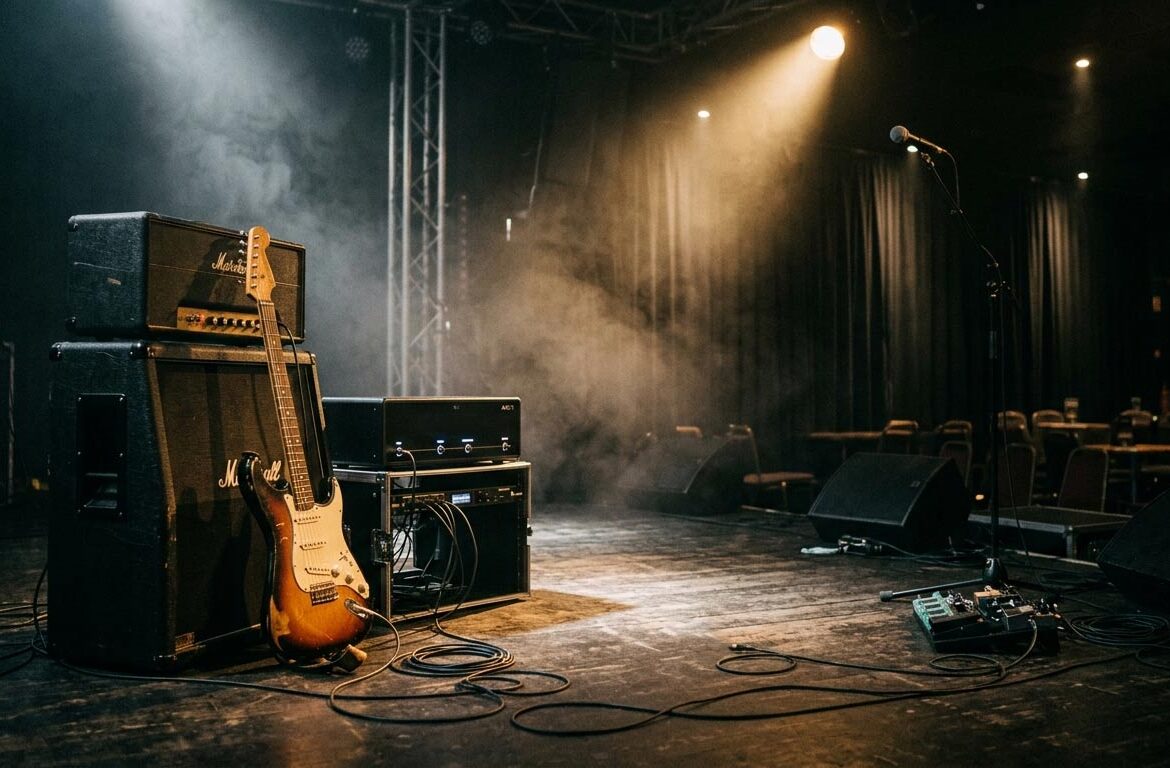

If you’ve played guitar live, you already know what we’re going to say.
You’re there hours before doors, hauling in pedalboards and an amp head that weighs more than it should, with a pile of cables you swear you’ll organize tomorrow.
Then there’s the tone. That rig you spent the last six months dialing in, only to have the sound guy or a different room have you wondering whose guitar you’re playing. And on a bad night, something gives out mid-set in front of a couple hundred people who paid to be there.
We’ve all been there. Weekend gig, festival slot, doesn’t matter.
It’s all about to change.
We’re a small crew of musicians and engineers who’ve been heads-down on this for a while. Specifics are around the corner, in the coming weeks we’ll start showing what we’ve been up to.
Stick around. Follow us on Facebook, X, and YouTube. And tell your guitar player.
Severed Circuits
It would be great if they included a transposition feature in the system—like on a digital piano—that allows you to change the key while maintaining precise, correct tuning. That way, if I want to play a song that’s in a difficult key, I could simply transpose it to one that’s easier to play. I’d also like to know why they didn’t include XLR inputs; I think that’s really important, especially since high-end modelers have them.
Hello and thank you for your interest! All inputs and outputs support XLR connections. There are two combo XLR/TS inputs, and two more TRS inputs that can be connected via XLR->TRS cables. Likewise, all 4 outputs also are both balanced & unbalanced, you can use either TRS->XLR cables, or regular TS instrument cables. Great idea on the transposition as well!